About this edition
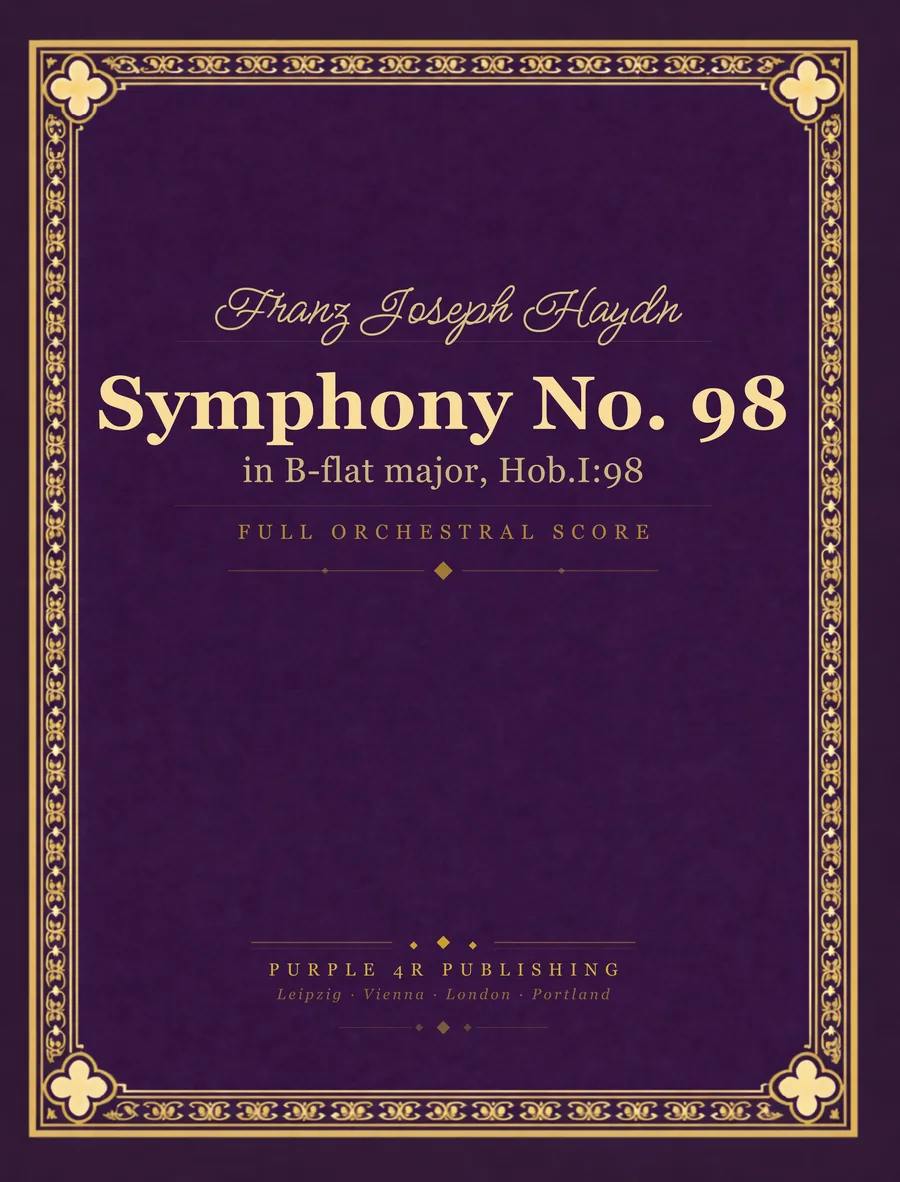
Composed in 1792 for Haydn's triumphant first London season, Symphony No. 98 in B-flat major stands among the most personal and emotionally searching of the twelve "London" Symphonies. Its Adagio second movement — widely understood as Haydn's elegy on the death of Mozart, with its unmistakable echoes of the slow movement of Mozart's Piano Concerto K. 488 and a quotation from "God Save the King" — is one of the most moving utterances in the late eighteenth-century symphonic literature. The finale's celebrated harpsichord solo, written by Haydn for himself to play at the keyboard during the premiere, is a unique flourish unmatched anywhere else in his symphonic output.
This reprint reproduces the full orchestral score published in Leipzig by August Cranz (publisher's number 2108, plate C.45070), an edition that descends from the nineteenth-century Central European publishing tradition that disseminated Haydn's symphonies to professional orchestras and conservatories across Europe. The Cranz firm, founded in Hamburg in 1814 and later operating from Leipzig, was a respected publisher of orchestral and chamber repertoire, and its Haydn editions circulated widely among working musicians during the height of the Classical revival.
About this edition:
- Full orchestral conductor's score
- Page size: 8.5 x 11 inches
- Reproduced from the August Cranz edition (Leipzig, plate C.45070)
- Sourced from a public domain historical score
- Published by Purple 4R Publishing
We're delighted to bring this historic edition back into print, making one of Haydn's most heartfelt symphonies readily available to conductors, performers, students, and scholars who want a reliable score on the stand or the desk. As a faithful reproduction of a public domain edition, it carries forward a piece of orchestral publishing history into a new generation of music-making.