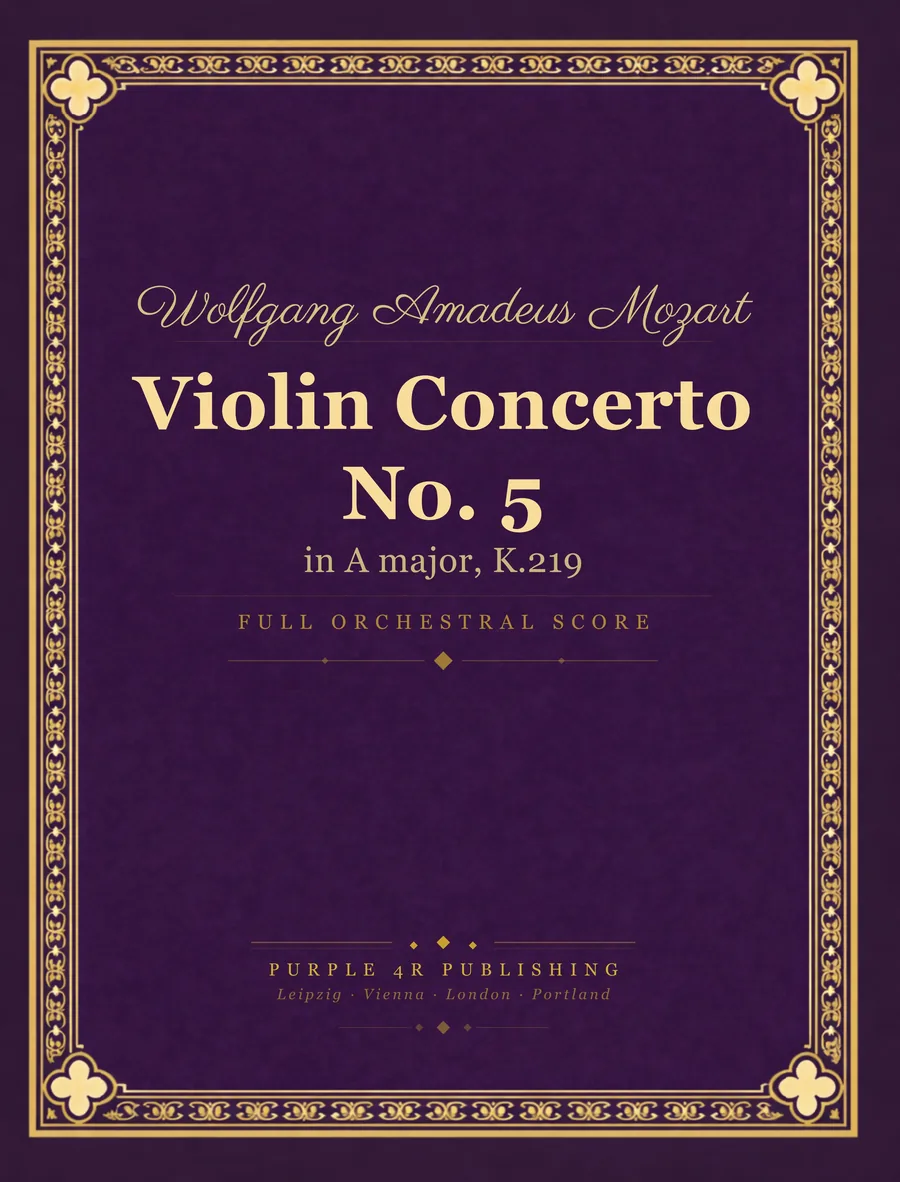
About this edition
Composed in Salzburg in December 1775, when Mozart was just nineteen years old, the Violin Concerto No. 5 in A major is the last and most extraordinary of his five violin concertos — a work that closes his brief but astonishing exploration of the genre on a note of pure invention. Its nickname, "Turkish," comes from the startling episode in the final Rondeau, where the music suddenly lurches into a stamping, percussive minor-key episode evoking the Janissary bands then fashionable across Europe, before returning as if nothing had happened to the concerto's elegant French-style tempo di menuetto. Beyond that famous surprise, the concerto is remarkable for its opening movement: rather than the expected orchestral tutti followed by soloist entrance, Mozart has the violin enter with a serene, improvisatory Adagio phrase entirely foreign to the Allegro aperto that surrounds it — a moment of formal daring rarely matched in the composer's other early concertos.
This edition reproduces the score as published in Mozarts Werke, Serie XII, Bd. 1, No. 5 (pages 113–144), issued by Breitkopf & Härtel in Leipzig in 1877 as part of the first complete critical edition of Mozart's works. The volume was edited by Ernst Rudorff (1840–1916), a composer and pupil of Moritz Hauptmann and Woldemar Bargiel who brought rigorous editorial standards to the Alte Mozart-Ausgabe's violin concertos. As one of the founding monuments of modern musicology, the Alte Mozart-Ausgabe established the textual basis from which nearly all subsequent performing editions have descended, making this Breitkopf & Härtel printing an essential historical reference for scholars and performers alike.
- Format: Full orchestral score
- Page size: 8.5 x 11 inches
- Source: Reproduced from the 1877 Breitkopf & Härtel edition (Mozarts Werke, Serie XII, Bd. 1), a public domain historical publication
- Publisher: Purple 4R Publishing
Because this historic score belongs to the public domain, we're glad to make it freely available again in a clean, sturdy printed edition — bringing Rudorff's careful nineteenth-century scholarship back to music stands, study desks, and libraries everywhere.