About this edition
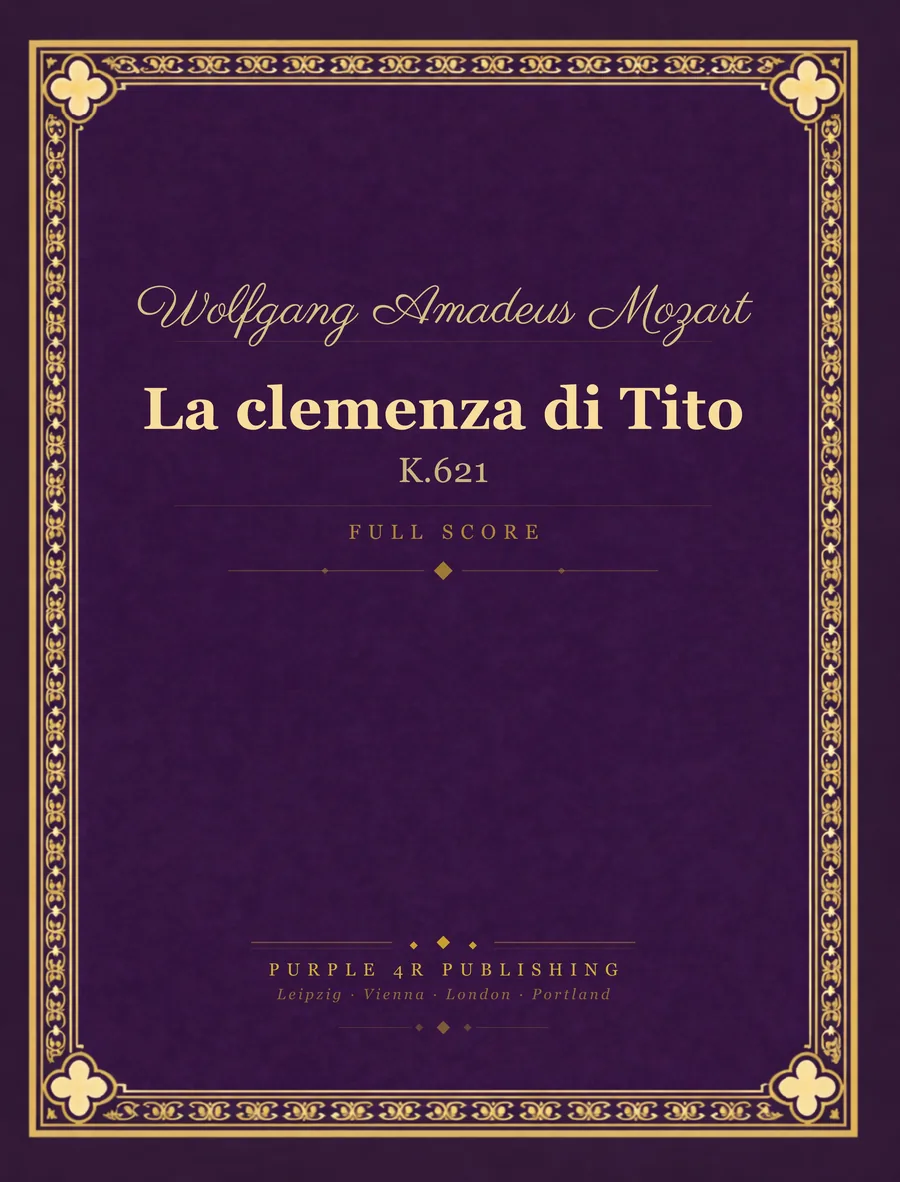
Composed in the final months of Mozart's life and premiered in Prague on September 6, 1791 for the coronation of Emperor Leopold II as King of Bohemia, La clemenza di Tito, K.621 stands as Mozart's last completed opera and his final return to the formal world of opera seria. Set to a libretto adapted by Caterino Mazzolà from Metastasio's much-revered text, the score is remarkable for its elegant economy, its luminous use of clarinet and basset horn (written for the virtuoso Anton Stadler), and arias such as "Parto, parto" and "Non più di fiori" that rank among Mozart's most sublime vocal writing. Long overshadowed by Mozart's Da Ponte operas, Tito has been embraced by modern audiences and scholars as a masterwork of restraint and dignity.
This volume reproduces the score as published in the landmark Mozarts Werke complete edition issued by Breitkopf & Härtel of Leipzig between 1877 and 1883. Appearing in Serie V, Band 11 (No. 21), the edition was prepared under the general editorship of distinguished nineteenth-century conductor-scholars including Julius Rietz (1812–1877) and Franz Wüllner (1832–1902). As the first scholarly attempt to gather Mozart's complete output, this Breitkopf edition served as the foundation of Mozart performance and study for generations and remains a touchstone reference even after the appearance of the later Neue Mozart-Ausgabe.
About this edition:
- Format: Full orchestral score (conductor's score)
- Page size: 8.5 x 11 inches
- Source: Reproduced from a public domain historical edition
- Original publisher: Breitkopf & Härtel, Leipzig, 1882 (Plate W.A.M. 621)
- Editors of the original edition: Julius Rietz and Franz Wüllner
- Reprint publisher: Purple 4R Publishing
This volume is a faithful reprint of a historical edition that has entered the public domain, making one of Mozart's most refined operatic achievements readily available to conductors, singers, répétiteurs, students, and devoted listeners. We hope it serves you well, whether on the podium, at the piano, or in quiet study.