About this edition
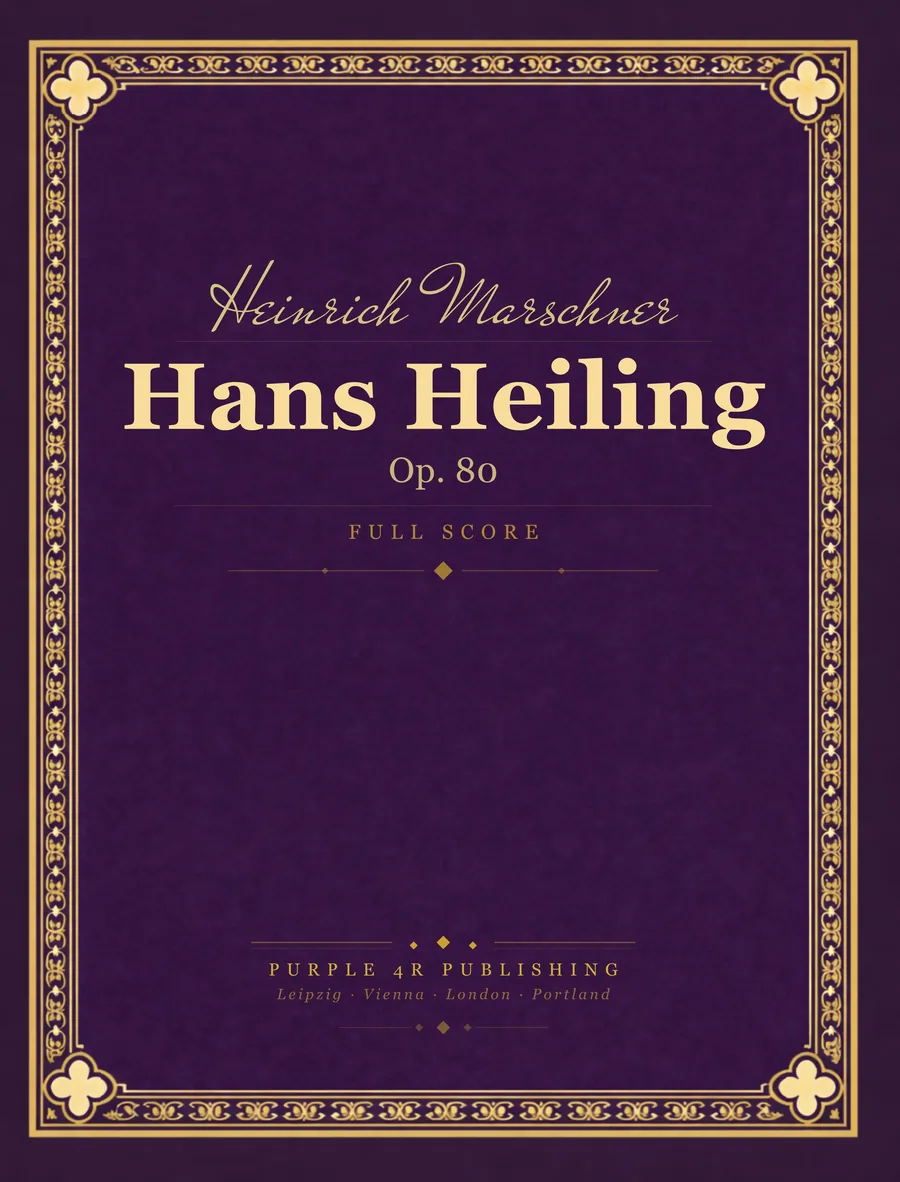
Heinrich Marschner's Hans Heiling stands as the composer's crowning achievement and one of the pivotal scores of German Romantic opera. Premiered in Berlin in 1833 to a libretto by Eduard Devrient, it tells of a Bohemian gnome king who abandons his subterranean realm for the love of a mortal woman, only to be undone by human faithlessness — a tale of supernatural longing and betrayal rendered with striking dramatic and orchestral power. The opera's atmosphere of eerie enchantment and its symphonic treatment of the orchestra pointed the way forward for the generation that followed, and its influence on the young Richard Wagner, who deeply admired Marschner's work, can be felt in the redemption dramas Wagner composed in the years afterward.
This edition reproduces the full orchestral score issued in Leipzig by Edition Peters, one of the most distinguished German music publishing houses of the nineteenth century, printed without a stated date but datable to circa 1892 from its plate number, 7682. The score was prepared by Gustav Friedrich Kogel (1849–1921), a respected conductor who edited numerous performing scores for Peters during this period and brought careful musical judgment to the task of readying Marschner's opera for practical use in the theater and rehearsal room. Peters full scores of this era were engraved for working conductors and orchestras, and they remain prized today for their clean engraving and dependable musical text.
About this edition:
- Full orchestral score
- Page size: 8.5 x 11 inches
- Reproduced from a historical public domain source
- Published by Purple 4R Publishing
Because this score's copyright has long since expired, we're delighted to bring this handsome historical edition back into print, making Marschner's masterwork freely accessible to conductors, orchestral musicians, students, and scholars alike. We hope you enjoy having this piece of operatic history on your shelf and stand.