About this edition
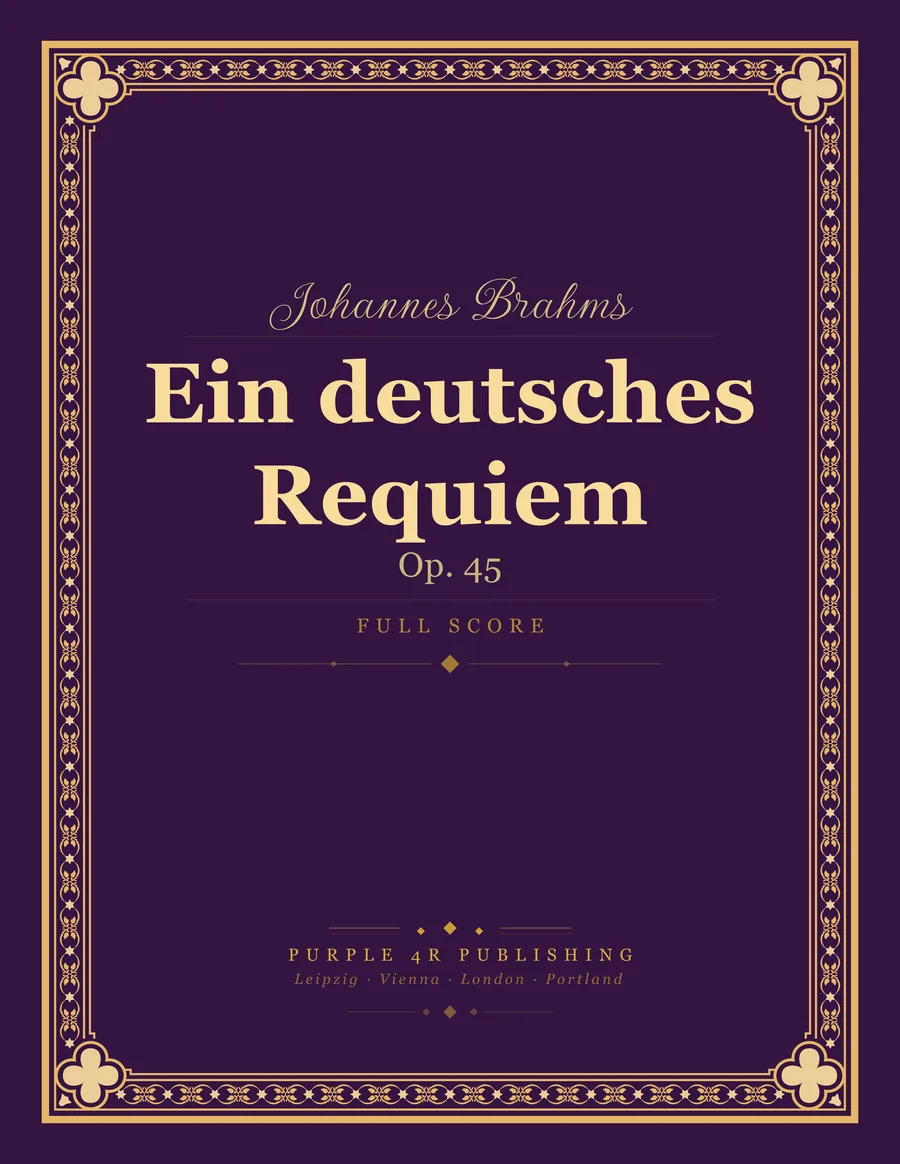
Composed in the long shadow of his mother's death and completed in the aftermath of Robert Schumann's passing, Brahms's Ein deutsches Requiem, Op. 45, stands apart from every other work in the requiem tradition. Rather than setting the Latin Mass for the Dead, Brahms assembled his own text from the Luther Bible, crafting a meditation addressed to the living — one that consoles mourners rather than pleads for the souls of the departed. Its seven-movement arch, framed by the serene choral statements "Blessed are they that mourn" and "Blessed are the dead," reveals Brahms at the height of his contrapuntal and orchestral mastery, and the work remains one of the towering achievements of the choral-orchestral repertoire.
This edition reproduces the first edition full score published by Rieter-Biedermann in Leipzig and Winterthur, under Jacob Melchior, plate number 592. Rieter-Biedermann was Brahms's trusted publisher during this crucial period of his career, and this print represents the authoritative early printed source for the Requiem's orchestral text as it was first disseminated to the musical public. The copy from which this reproduction derives carries additional historical weight as part of the Teilnachlass Julius Spengel held at the Brahms-Institut an der Musikhochschule Lübeck, connecting this score to the documented performance history and scholarly legacy surrounding Brahms's own circle.
About this edition:
- Full orchestral score, faithfully reproduced for study, performance preparation, and reference
- Page size: 8.5 x 11 inches
- Reproduced from a public domain historical source
- Published by Purple 4R Publishing
Because this score has entered the public domain, we're delighted to bring this historic first edition back into print — making Brahms's masterwork freely accessible to conductors, orchestras, students, and scholars who want to study and perform it from a genuinely authoritative source.